
TL;DR
With convection (fan) cooking, the tray has a correct orientation: slide it in with the beveled edge toward the back (toward the fan) for better airflow and more even browning.
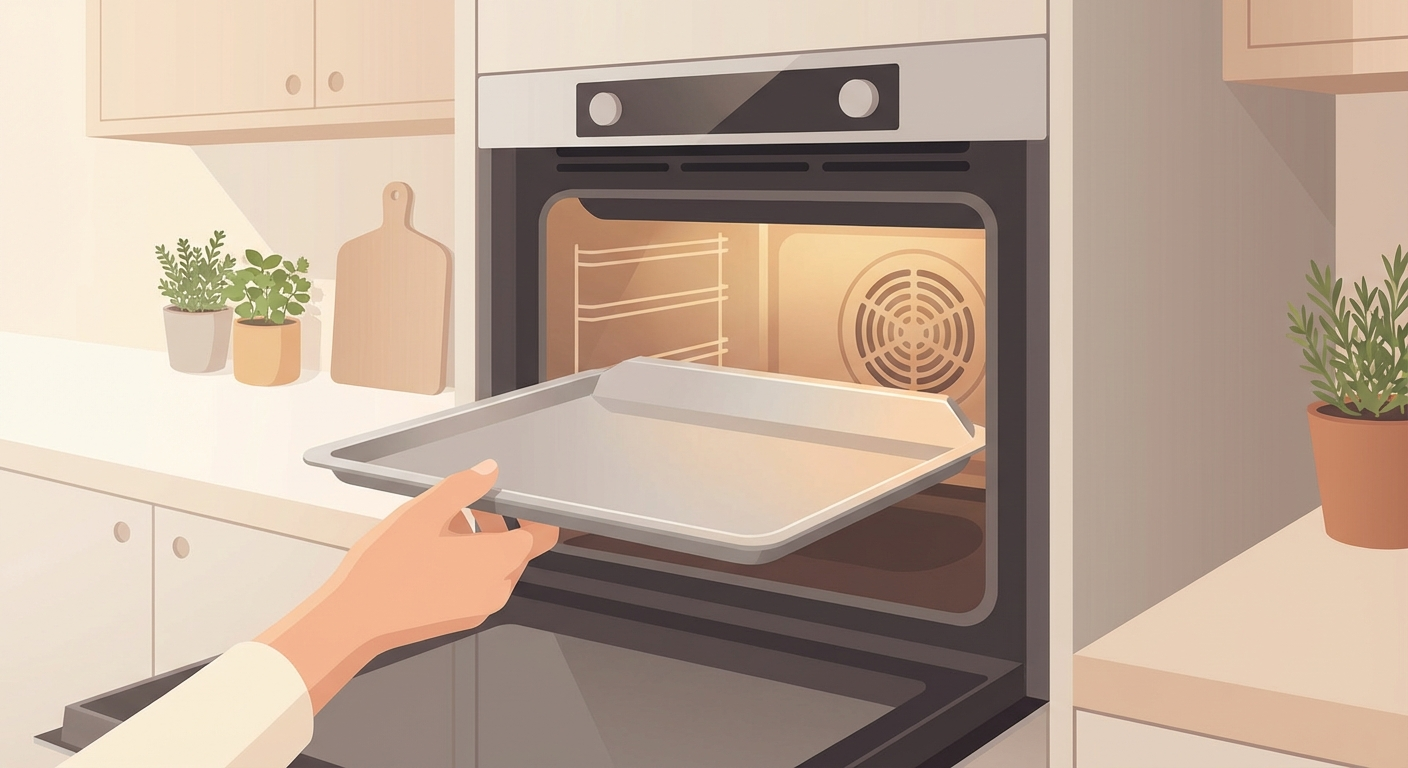 Most people slide their oven tray in without thinking. But look closely: one edge is usually **beveled** (angled or sloped) and the other is straight (a raised lip). That's not random — it's designed for airflow. ## The rule For **convection / fan cooking**, slide the tray in with the **beveled edge facing the back** — toward the fan. ## Why it matters The fan pushes hot air forward. When the beveled edge faces the fan: - **Air flows smoothly** over and under the tray instead of hitting a wall - **Heat distributes more evenly** — fewer hot spots near the edges - **Food browns uniformly** — no burnt corners with a pale center - **Crispier results** for pizza, fries, vegetables, and baked goods With the tray reversed (lip toward the fan), the raised edge blocks airflow, creating a pocket of stagnant air behind it. That's why the back row of cookies sometimes burns while the front stays pale. ## How to check your tray Pick up your tray and look at both short edges: - **One edge** has a low, angled slope (the bevel) — this goes **toward the back** - **The other edge** has a higher, straight lip — this faces **toward the door** Some trays have both edges beveled equally — in that case, orientation doesn't matter. ## Quick rule **Bevel to the back, lip to the door.** ## Does it matter for top/bottom heat only? Less so. Without a fan, heat rises naturally and the tray orientation has minimal impact. But it doesn't hurt to keep the habit — especially since most modern recipes use convection.