
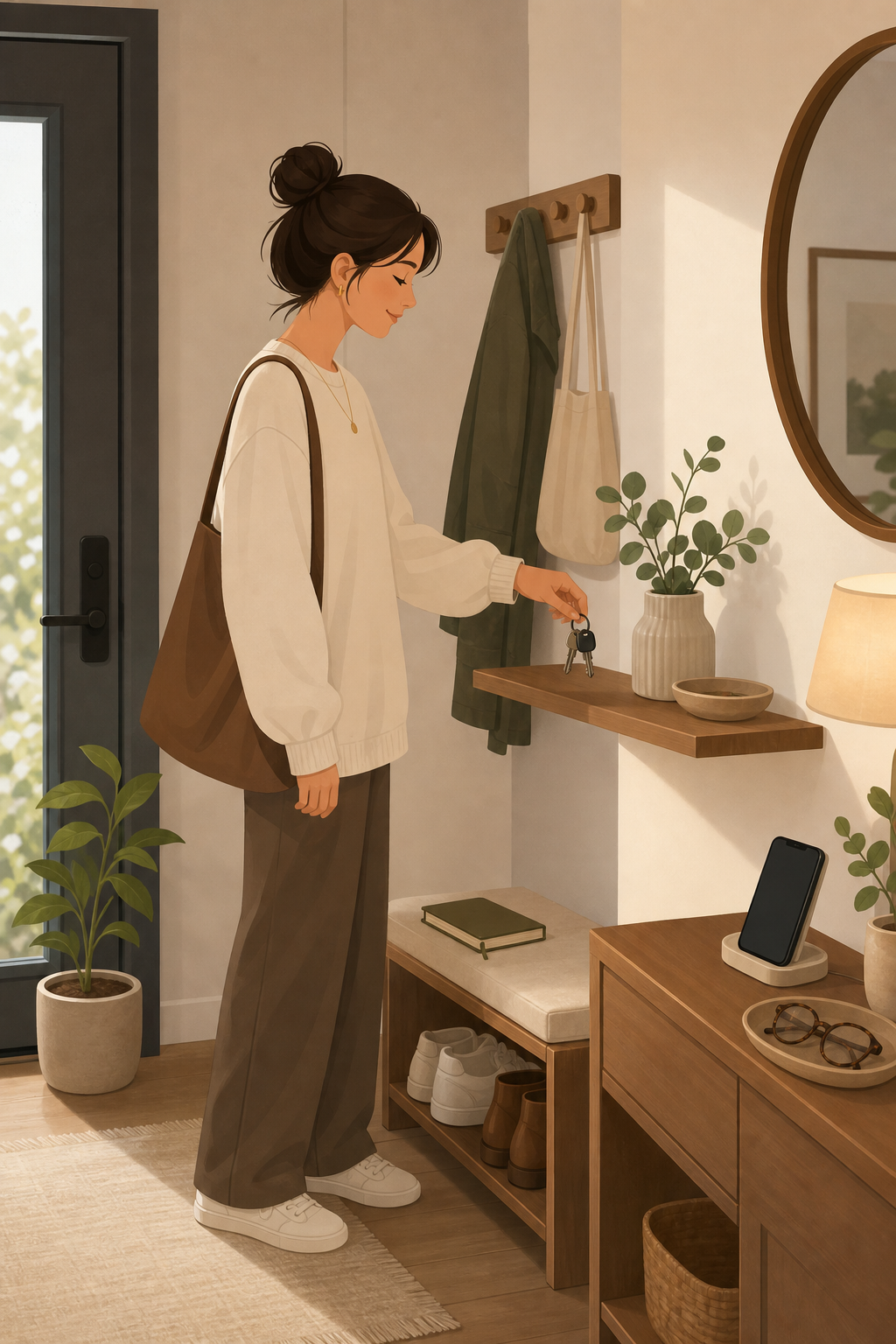
How to do it
Pause for one second before you put down keys, glasses, tools, papers, headphones, or anything you often lose. Look at the spot and say one complete sentence out loud: "The keys are on the hallway cabinet." Or: "The notebook is on the chair next to the door." It may feel slightly silly at first. That is fine. The useful part is not elegance; it is forcing your attention to touch the moment.
Why it works
Most misplaced objects are not lost because the place is hard to remember. They are lost because the action happened on autopilot. You were walking through the house, answering someone, carrying three things, or switching tasks. Saying the location out loud turns a throwaway movement into a recorded event. You create a visual cue, a spatial cue, and an auditory cue at the same time, which gives your brain more ways to retrieve it later.
Better examples
Make the sentence specific. "My sunglasses are in the top pocket of the backpack" is better than "The glasses are in my bag." "The letter is on the small table beside the entrance" is better than "The letter is somewhere in the hallway." The more exact the location, the more useful the memory becomes. For items you misplace often, reuse the same pattern: item, room, exact place.
When not to rely on it
This is a memory aid, not a system for important objects. Passports, medication, contracts, house keys, and anything with a deadline deserve a fixed home. Use the out-loud sentence for temporary situations: packing, taking a call, clearing a table, tidying up, or putting something down because you were interrupted.